
To say the first economicology curriculum in town is up and running after one semester is not exactly true. Students at City High/Middle School have raced out of the gate to implement the principles of balancing the economy with the ecology. Peter Wege has advocated this philosophy since starting The Wege Foundation over 40 years ago, and he coined the term economicology to summarize it. The Wege Foundation is now sponsoring a premier Grand Rapids Public School to pioneer this environmental-financial approach to education.
And, to be precise, the first students whose classes are infused with economicology values actually jumped the starting gate before the doors opened in the fall of 2008. As school let out last spring, City High students in the Environmental Club decided they’d had enough of watching everyone’s lunch leftovers fill up trash bags. They needed to do something about it, and September was too far away.
Some of the E Club students actually followed garbage trucks and saw all their school’s food refuse end up in the dump. They recognized this as negative economicology. Pay for dumping and damage the environment. Their solution? Composting.
Over the summer they interviewed the food-service people at San Chez and the Grand Plaza Hotel knowing those restaurants both composted. They found out that environmental haulers named SPURT were the ones who did the composting. They also found out how strict SPURT’s rules are to ensure only food waste gets into the composting containers.
When school opened last fall, composting was in place at City High/Middle . No extra staff time (cost!) was needed because student volunteers did it all. Principal Dale Hovenkamp noted there was “a learning curve for a while.” Faculty and students had to learn how to sort and separate foods and dishware into the correct recycle bins.
By second semester 2009, after-lunch sorting was second nature. According to Principle Hovenkamp, the composting project has raised awareness for all the 620 seventh-through-twelfth grade students at the school on Fuller. “This is a very smart group of kids,” Hovenkamp makes clear. “They understand why we need to do these things.”
The ripple effect of this economicology transformation is already happening. East Grand Rapids High School students heard their friends from City High talking about it, and they wanted in. East students have now checked out how City’s composting program works…they plan to go therefore and do likewise at their own school.
Yet more to come at City High/Middle? A wind turbine. Boycotting the sale of bottled water. Using their compost on apple trees started in the school science labs to be planted on school property. Selling CFL (compact fluorescent Light bulbs) to save energy and raise money for more economicology projects.
No, the kids who jumped the gun last summer using economicology to make theirs a better world haven’t even made the first post around their track.
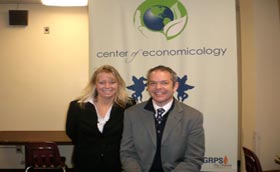
Brandie Perry from The Wege Foundation is shown with Dale Hovenkamp, principal of City High/Middle School–part of the Grand Rapids Public School System. The poster behind them represents the new economicology curriculum that started in the fall of 2008 and is being taught across the curriculum in all six grades, 7th-12th. Funded by The Wege Foundation, the curriculum is based on Peter Wege’s economicology principles that advocate a balance between the economy and the environment.


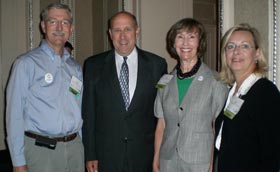
 Seven representatives of The Wege Foundation, including Trustees Mary Nelson, Peter Wege II, and Ellen Satterlee, attended the 4th Annual Great Lakes Restoration Conference in Milwaukee September 10-12. Most appropriately, the seven Wege Foundation delegates traveled from Grand Rapids to Milwaukee by crossing Lake Michigan on the Lake Express ferry.
 As the only child of Peter Martin and Sophia Dubridge Wege, Peter M. Wege began honoring their memory half a century ago. Because of his mother’s strong Catholic faith, her son often used his gifts to church causes as an opportunity to memorialize his parents. His first major gift in 1959 went to help build Alburtus Magnus Hall of Science for Aquinas College.
 After one year in operation as the world’s first art museum to win a Gold LEED medal from the United States Green Building Council, the Grand Rapids Art Museum has doubled its attendance. The new GRAM welcomed twice as many people to its galleries in one year as the number of those who visited GRAM in its last year in the former federal building.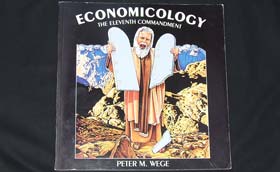
 Thanks to The Wege Foundation, the Grand Rapids Public Schools are infusing Peter Wege’s concept of economicology into the curriculum. Wege coined the word economicology to define the balance needed between the economy and the ecology. The word summarizes Wege’s advocacy for educating the public on the reality that a prosperous economy depends on maintaining a healthy environment.
 The forward-thinking president of Costa Rica Oscar Arias Sanchez has launched an international conservation effort that could help save 4% of the world’s biodiversity. Called the Peace With Nature Initiative, President Arias’s plan continues the visionary environmentalism Costa Rica began two decades ago.
 In late July, 2008, The Wege Foundation invited friends from several West Michigan foundations to meet University of Pennsylvania professor Dr. Dan Janzen and his wife Dr. Winnie Hallwachs Janzen and learn about their conservation work in the Costa Rican rain forest. Since Peter Wege first met the Janzens in 1991, The Wege Foundation has supported their work buying private land to be permanently preserved. The two Dr. Janzens have worked closely with the Costa Rican government to help the Central American country become the global leader in conserved park land relative to its size.
 The 2008 Climate Leadership Summit of the American College & University Presidents’ Climate Commitment concluded its two days of meetings in Grand Rapids, Michigan, on June 6. Speaking at the closing luncheon, the chairman of the ACUPCC and president of Arizona State University, Michael M. Crowe did not tiptoe around the sensitive topic of membership.